Fort Montgomery State Historic Site
Park Update
Alert: The 1777 West, 1779, Timp-Torne and Popolopen-Torne Trails remain inaccessible from the site due to storm damage.
Fort Montgomery State Historic Site Update
Trail Closure: The Twin Forts Trail, which runs behind the Fort Montgomery Museum across the Popolopen Creek to the Trailside Museum and Zoo, will be closed for renovation November through December. We apologize for any inconvenience.
690 Route 9W
Fort Montgomery, NY 10922
- General Information: (845) 446-2134

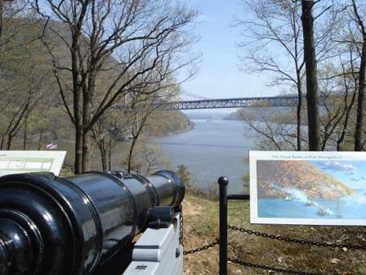
Fort Montgomery was the scene of a fierce Revolutionary War battle for control of the Hudson River. Visitors today can tour the remains of the 14-acre fortification, perched on a cliff overlooking the magnificent Hudson. On October 6, 1777, British, Loyalist and Hessian forces attacked Fort Montgomery and nearby Fort Clinton. The defending American Patriots, outnumbered 3 to 1, fought desperately until driven out of their forts at the points of the enemy bayonets. More than half of the Patriot forces were killed, wounded or captured.
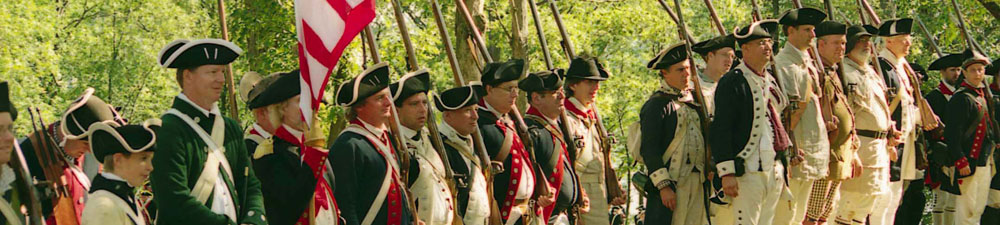
Visitors can learn about this important military post at the site's museum, which showcases original artifacts and weapons, large scale models of the fort and the attack, highly detailed mannequins frozen in poses of battle, and an action packed fifteen minute movie of the 1777 assault. Archeologists have revealed many of Fort Montgomery's remains, including stone foundations of barracks, the gunpowder magazine and eroded redoubt walls. There is a spectacular view of the Hudson River from the Grand Battery, where reproduction cannon stand guard and are occasionally fired by the fort's staff. The past comes alive at Fort Montgomery with living history demonstrations of artillery, musketry, music and camp life activities.
P.O. Box 213 Fort Montgomery, NY 10922
Hours of Operation
- Fort Montgomery is open
Wednesday through Saturday from 10 AM to 5 PM
and Sunday from 1 PM to 5 PM, Mid-April through October.
During the off-season,
Fort Montgomery is open by reservation for group tours depending on staff
availability and weather.
For more information,
please call 845-446-2134.For More Information on Special Events and Programs please check our Site Facebook Page: https://www.facebook.com/FortMontgomeryStateHistoricSite.
Fees & Rates
- Fees & Rates
Access to Fort Montgomery is free to visitors during regular hours. Donations are welcome. Some program fees for tours and evening events are charged, please call the site for information.
Maps
Group Tours:
Tours are available to organized groups (including schools, scouts, military units) during the site's operating season, Wednesday through Sunday. Tour cost is $5 per person. Please call the site at 845-446-2134 for more information or to book a tour.
During the off-season, Fort Montgomery is open by reservation for group tours Monday through Friday. For more information, please call 845-446-2134.
All Group tours are dependent upon weather and staff availability and must be booked in advance.
Weekend Tours:
During our operating season (mid-April through October) free tours are available to the public on Weekends: Saturdays 11am, 1pm and 3pm, Sundays 1pm and 3pm. Tours last 60 minutes
In the Hour of Their Country's Trial: The Battle of Fort Montgomery, October 6, 1777
Fort Montgomery's museum exhibits include original items excavated here in 1967-71, associated artifacts from museum collections, large scale models of the fort and highly detailed mannequins frozen in poses of battle. Together they tell us about the people who lived and fought here. The artifacts have been divided into three categories: those representing the weapons used here, those revealing the material culture of the soldiers, and those related to the building and destruction of the fort.
The Combatants
Sergeant, British 52nd Regiment of Foot
This infantryman is in the act of loading his fusil, a short, light-weight musket carried by sergeants and officers. His uniform consists of a red regimental coat with buff facings and white buttonhole lace, buff waistcoat and breeches, and black half-gaiters over his shoes to keep out stones and dirt. In addition to the silver lace on his black cocked hat, his rank is indicated by the sash around his waist and hanger, or short sword at his side.
Private, Loyal American Regiment, attached to Emmerich's Chasseurs
The chasseurs (sharpshooters) consisted of 100 troops drawn from five Loyalist regiments. In 1777, all Loyalist units were clothed in green regimental uniform coats with white facings, white wool breeches and waistcoat, and a black cocked hat trimmed with white tape and a black military cockade. This particular chasseur is dressed in a non-regulation coat that has been shortened for ease of movement through rough terrain. His hat has likewise been cut down in size. He is taking aim with a rifle, a much more accurate weapon than the usual military musket of the era.
Privates, Ulster County Militia and 5th New York Regiment
The militia was not a component of the regular Continental Army. Instead, it consisted of local citizens who were called into service in an emergency by their state governments, and usually for a short term. Thus, the militiaman on the left wears a civilian coat, vest, and breeches. He is carrying a British Long Land Pattern 1742 musket, probably obtained from a pre-war British arsenal. He assists a wounded private from the 5th New York Regiment. Authorized by the Continental Congress in November 1776, the 5th recruited men from Ulster and Orange Counties. This soldier's brown regimental coat with blue facings is adorned with buttons bearing a joined "NY" emblem. His vest has buttons marked "USA." Suffering from a wounded leg, he leans on his French Model 1728 musket, one of the thousands of weapons secretly supplied to the Patriots by France in 1777.
Weapons of War
Objects dropped or discarded at Fort Montgomery provide archeologists and historians with a wealth of knowledge about military equipment, uniforms, and activities. Gun parts and musket balls reveal the types of weapons employed by both British and American forces. Buttons indicate military units and the clothing of some of the participants. They even show that some British uniforms had been captured and were being worn by American troops. Wherever possible, archeological artifacts from Fort Montgomery are shown close to corresponding locations on complete original weapons of the period. British, French and American muskets are displayed as well as swords, bayonets and artillery projectiles.
A City in the Wilderness: Food Vessels
The types of food vessels found in the officers' and enlisted men's quarters reveal differences in social status between the two groups of men. Lead-glazed, slip-decorated buff earthenwares were old-fashioned, utilitarian vessels used for food storage and preparation and for liquid-based foods, such as soups and stews. These wares were found in greatest numbers in the enlisted men's barracks. Creamware and white-glazed stoneware were a more refined type of ware, consisting of flat plates in matched sets used for serving individual portions of meat, such as slices from a roast, that required the use of a knife and fork while sitting at a table. These white-toned ceramics were found in higher proportions in the officers' quarters. Here visitors may view porcelain and salt-glazed stoneware items, case bottles, buff earthenware platters and bowls and a number of posset pots.
A City in the Wilderness: Personal Items
Fort Montgomery was a bustling community of hundreds of people. Soldiers, laborers, merchants, families, servants, and slaves lived at or visited the fort. Ships and boats arriving and departing added to the atmosphere of a small city. The inhabitants of the fort worked, cooked, baked bread, butchered meat, mended clothing, fished, ate, got sick, took medicine, smoked, drank tea, drank wine, drank punch, wrote letters, entertained themselves and each other with music and games of chance, and slept—all activities that went on in the villages and farms from which they came. Items on display in this case include clay pipe fragments, bone handled forks, pins, jaw harps, coins, buckles, spoons, cuff links, buttons, and animal bones.
Built and Destroyed
The construction of Fort Montgomery began early in 1776, and it fell to the British in battle on October 6, 1777. The British occupied the fort for a few days and then razed it before moving on. They destroyed the iron chain, burned the buildings, knocked down the chimneys, carried off or sank the guns, blew up the powder magazine, and took anything else of value with them. What remained were burned-out foundations and tumbled-down earthworks. The variety of burnt items on display serve as a testament to the thoroughness of the fort's destruction. Also on display here is a link of Fort Montgomery's chain, raised from the river bottom by fishermen in 1861.
In Pursuit of Fragile Liberty
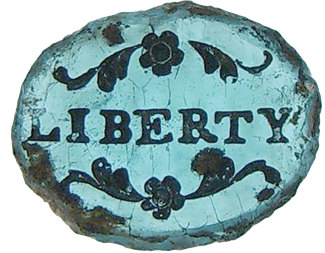
Two of the smallest yet most important objects found during the archeological excavations at Fort Montgomery were these delicate jewels from a cuff link, impressed with the word "LIBERTY." Similar examples were found at a Continental Army barracks site in northern Manhattan and may ironically have their origins in the "Wilkes and Liberty" movement of pre-war Britain. Transplanted to America and worn by an American soldier during the battle, they would have symbolized the resolute hope of Fort Montgomery's defenders.
Saturday, August 15, 2026 01:00 PM - 03:00 PM
Fort Montgomery State Historic Site
Saturday, September 5, 2026 10:00 AM - 04:00 PM
Fort Montgomery State Historic Site
Saturday, September 26, 2026 11:00 AM - 12:00 PM
Fort Montgomery State Historic Site
Saturday, October 3, 2026 10:00 AM - 04:00 PM
Fort Montgomery State Historic Site
Saturday, October 10, 2026 10:00 AM - 04:00 PM
Fort Montgomery State Historic Site
Amenities Information
- Amenities
- Costumed Interpreters
- Demonstrations
- Hiking
- Tours
- Visitor Center (Accessible)